


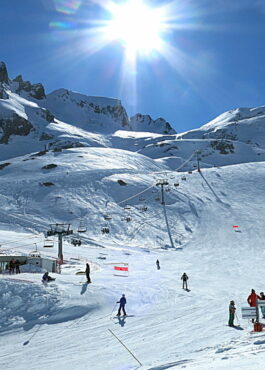
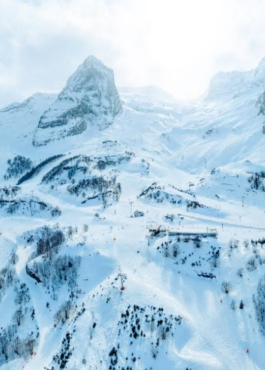




Ski touring is no longer reserved for vast wilderness areas. In Gourette, as in all resorts, more and more practitioners are now choosing ski resorts to learn or train: perceived safety, easy access, marked slopes… However, this reassuring setting can quickly make one forget that the mountains remain an unpredictable and potentially dangerous environment , even in ski areas.
In this article, we review the main risks associated with ski touring in resorts — and the best practices to avoid them.
🎿 1. Coexisting with skiers
The trails are primarily designed for downhill travel. Hikers who ascend against the flow of traffic risk:
Collisions
In Gourette, as in all resorts, ski tourers often ascend against the direction of downhill skiers . This significantly increases the risk of:
- collisions with fast skiers,
- loss of control resulting in violent impacts,
- visibility difficulties on breaks in slope and in narrow passages (especially around the Cotch or Pène Blanque sector).
Alpine skiers, often fast, don't expect to encounter a hiker in the middle of a slope. A loss of control can lead to a serious accident.
In the event of a serious accident, there will be an investigation to determine liability:
The responsibility ultimately lies with the ski tourer who goes against the flow of skiers. It's important to understand that mountain accidents trigger a significant deployment of the rescue chain: helicopter, ski patrol, resort doctor, and mobilization of state forces such as the gendarmerie and the PGHM (High Mountain Gendarmerie Platoon). This includes the repatriation of the victim, hospitalization, etc.
Not to mention the ensuing consequences, additional costs and/or compensation for lost wages for the victim, etc…
If the case goes to court, all these costs incurred will be borne by the person found responsible.
☠️⚠️2. The very real danger of snow groomers
Outside of opening hours, the snow groomers often work with winchThe cable — taut, invisible, sometimes several tens of meters away — is one of the most dramatic accident scenarios.
Even a simple moving snow groomer represents a major risk if the driver does not see you.
- A snow groomer in full maneuver; fresh snow creates a cloud in front of the windshield, limiting visibility.
- A cable stretched across a slope can move like a whip when the snow groomer angles up.
- Breaks in slope are areas where a driver cannot see you.
👉 For your safety and the peace of mind of the snow groomers, all traffic on the ski area is prohibited outside of opening hours . This is one of the major dangers of ski touring in a resort.
👉 For the snow groomers, it's a real nightmare, and those who have lived through this experience rarely, if ever, recover!!!
🏔️ 3. The risk of avalanches does not disappear in the resort
Beyond the slopes
Even though part of the area is secured, the snow remains a dynamic environment. Ski touring in a resort often involves moving around:
- outside of the damage,
- on the edges of the runways,
- on unmonitored routes,
- on areas dependent on higher slopes.
As a result , avalanches can still occur, especially in unstabilized areas or during/following a snowfall event.

PIDA Avalanche Triggering Plan
Ski patrollers implement a preventative avalanche control plan after each snowfall. The natural terrain doesn't always allow the lookout to see if a hiker is in the path of an avalanche chute. It's never possible to know the exact size of an avalanche; it can sometimes be surprising and cross trails far from the controlled avalanche path.
👉 Avalanche gun shots (cannon with explosive shaft) can be fired from several hundred meters away on opposite slopes where the hiker may believe himself to be safe.
🌙 4. The false sense of security
At the ski resort, people often think they are "protected". But:
- Some slabs or avalanches can form during the day in closed areas.
- The weather changes just as quickly as off-piste skiing.
- Rescue services sometimes take longer to respond outside of open ski runs.
Avalanche transceiver-shovel-probe equipment remains essential , even on a route that is “part” of the resort.
🧭 5. Routes are not always controlled
Some hikers take improvised routes, drawn by a slope or a more direct line. However:
- Not all sectors are safe.
- Some areas lead to cliffs, streams, or prohibited zones.
- The boundaries of the domain can be crossed without realizing it.
⏳ 6. Risks related to schedules
Ski touring in resorts is often practiced early in the morning or in the evening, outside of the opening hours of the slopes.
That's precisely when:
- The snow groomers are moving,
- Security operations are taking place.
- Visibility is reduced.
- The rescue services are not yet fully operational.
A route that is permitted during the day may be prohibited or dangerous at night.
✅ How to practice safely?
Here are some simple but essential tips:
✔️ Check the permitted routes
Stations often offer specific routes: they are designed to avoid dangerous areas.
✔️ Respect the schedules
If the station closes a route, it's never for no reason.
✔️ Keep a complete set of equipment
DVA, shovel, probe, headlamp, water, warm clothes… even for just one hour.
✔️ Stay visible
Headlamp, reflective clothing, tracking app: everything helps snow groomers and skiers to spot you.
✔️ Never climb in the middle of a descent
Always stay on the edges or on a dedicated route.
🎬 In conclusion
Ski touring in a resort can be a fantastic experience: accessible, progressive and safe… provided one remains aware of the real risks..
Just because you can see the pylons of the chairlift doesn't mean the mountain becomes a safe playground!
With good preparation, a suitable route and constant vigilance, the practice remains an exciting and beneficial activity, both for the body and the mind.
